Nowhere people: Edward Hopper’s life in art

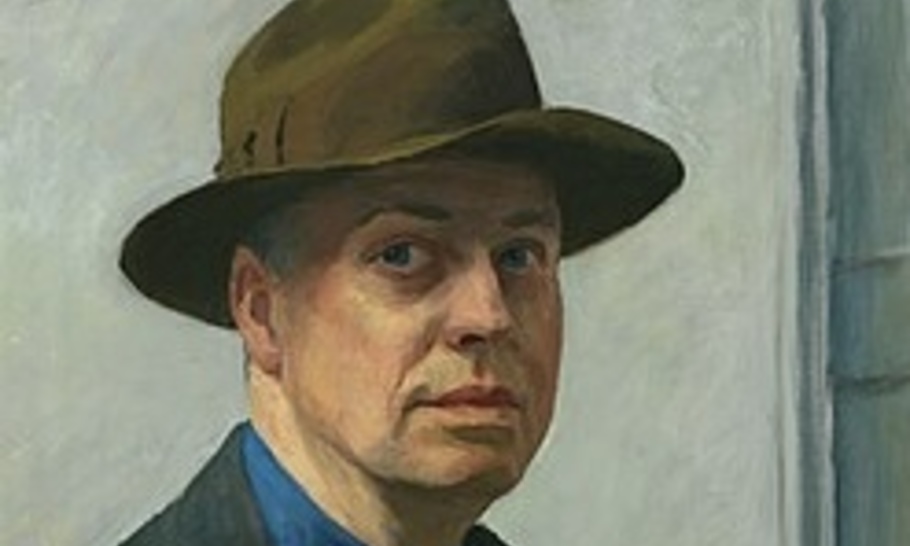
Edward Hopper (1882-1967) was a close contemporary of T. S. Eliot (1888-1965) and both men were trapped in puritanical reserve. Eliot’s lines in “The Love Song of J. Alfred Prufrock”— “lonely men in shirt-sleeves, leaning out of windows” and “restless nights in one-night cheap hotels”—express the somber mood of Hopper’s paintings.
Hopper was a dull fellow with no close friends and few dramatic events in his life, and his biography by Louis Shadwick is unable to enliven him and make him interesting. Six feet four inches tall, Hopper was prematurely bald, with strong teeth, big mouth and thick lips. Cryptic, ironic and evasive, the lonely, withdrawn, solemn man was quiet as a tomb and unafraid of extended silences. He often seemed on the verge of saying something, but held back and didn’t speak. His wife Jo noted, “There is something so disgusting about his salient characteristic egomania. He says he knows he is selfish—but can’t realize how selfish.” The actress Helen Hayes, who lived in Hopper’s birthplace, Nyack, New York, declared, “I never met a more misanthropic, grumpy, grouchy individual in my life.”
On his first visit to Paris in 1906 Hopper stayed in a room in a Protestant Church and, though not religious, dutifully went to service on Christmas Eve. He saw and disliked the art of Paul Cézanne, Henri Matisse and Edouard Vuillard. He knew about Gertrude Stein, never heard of Picasso who was then painting Les Demoiselles d’Avignon, and didn’t meet anyone in Paris. The artist had a radically deficient sensibility and remarkably poor taste. He hated California and Californians. He was unimpressed by the spectacular scenery of the Rocky Mountains in New Mexico, and found colourful Santa Fe cramped and disappointing, cluttered and mangy. The Grand Canyon made no great impact, and Sandro Botticelli’s The Birth of Venus was “only another pretty girl picture”.
Hopper was a great reader, and his themes, characters and locales were related to the American literary realists: Frank Norris, Theodore Dreiser, Sherwood Anderson and Sinclair Lewis, and to the realistic art lineage of his American predecessors Winslow Homer (1836-1910) and Thomas Eakins (1844-1916). He admired the art of Rembrandt and Edgar Degas, and his own paintings have the emptiness and solitude of Giorgio de Chirico and René Magritte.
Many set designers have looked for inspiration to Hopper, whose paintings have influenced countless films. Room in New York: The Killing and many other gangster movies have shabby rooms with solitary figures waiting for their next caper. Hopper’s High Noon: the last scene in The Unbearable Lightness of Being when the actress Lena Olin receives news that her friends have been killed in a car crash. Nighthawks: the last scene in John Huston’s Fat City when the two hostile boxers, played by Stacy Keach and Jeff Bridges, meet in a dreary café. The Mansard Roof: the main setting in Sophie’s Choice. House by the Railroad: the spooky shadowy house in Alfred Hitchcock’s Psycho. Four Lane Road: the scene of Daisy Buchanan’s fatal accident in The Great Gatsby. One tall red gas pump with a round white face is seen at the side of the house, the other appears through the window of the house. Myrtle Wilson, in a red dress that matches the pumps, hangs out of the window looking for the car of her lover. Her husband George sits outside with a grim expression and waits despondently to murder the innocent Gatsby.
Louis Shadwick’s Edward Hopper: A Life. (Yale UP, 504p, £30/$40) is well-illustrated with 40 colour plates and 106 well-placed black-and-white figures. Based on a dissertation at the Courtauld Institute in London, this book has many academic weaknesses. Shadwick has created a detailed chronology of Hopper’s life and rather mechanically follows him from place to place, painting to painting. He writes: “early in 1912, beginning of 1912, summer of 1912”; “the rest of the year, the first day of 1960, by January 20.” The author has a rather leaden clichéd style: “Edward must have felt a surge of excitement and independence as he approached New York’s iconic skyline on the Hoboken ferry, and docking at the famous port of New York.” He also offers banal comments: “In Train and Bathers, Hopper introduced the train itself”; “the Italian Quarter since the 1890s had been home to Italians.” His obvious comments on the historical background resemble television bulletins: “It was a fragile period in America. Though the Great War had ended, in its wake the nation reeled.” Instead of trying to interest the reader, Shadwick throws in all the facts he’s found. He repeats deadly lists of obscure people; he names all four companies that Hooper worked for as a commercial artist, including Samuel W. Peck & Co.; and he discusses about 185 often similar works of art instead of concentrating on the most important ones.
Shadwick makes several errors. The Queensborough Bridge connects Manhattan to Queens, not to Brooklyn. Rudyard Kipling mainly wrote stories and poems, not novels. Ernest Renan’s Life of Jesus is a biography, not a novel. Walt Whitman’s Specimen Days and Ulysses Grant’s Personal Memoirs were autobiographies, not “romantic narratives.” No visible evidence in Hopper’s Female Nude on Window Balcony in Paris shows that she represents his fear of venereal disease.
More information would enchance the meaning of the book. Shadwick lists all the plays and movies that Hopper saw, but does not give his reaction to them. Gloucester, Massachusetts, where Hopper often painted, is the setting of Kipling’s Captains Courageous (1897); Monhegan Island, another favorite locale, is 40 miles off the coast of Boothbay Harbor, Maine. One girlfriend called Hopper “a most astonishingly impatient person” because he was eager to have sex with her. He said, “people in Paris seem to live in the streets, which are a hive from morning to night.” Most of those people were poor, wanted to escape from their shabby rooms and find a congenial social life in the popular cafés. He was horrified by a 1907 bullfight in Madrid. In those days the picador’s horses, not protectively padded until 1928, were disemboweled.
The author overrates his subject by asserting, “by any measure, Hopper stands among the world’s most celebrated artists”. But his comparisons to artists with greater technical skill, vital interest and depth of meaning make them all appear clearly superior to Hopper. The woman in Degas’ powerful Absinthe Drinker (1876) is infinitely more poignant and tragic than Hopper’s distant and vaguely portrayed woman in Nighthawks. Degas’ The Rape (1869), where both the woman and the man are shown in post-coital anguish, shows the limitations and weakness of the sexual aftermath in Hopper’s Summer Interior. Andrew Wyeth’s woman crawling up a hill toward the lonely house in Christina’s World (1948) is infinitely better than Lighthouse Hill. Wallace Stevens’ “Sunday Morning” (1915) has the religious themes and sympathy with nature lacking in Early Sunday Morning. The poem brilliantly concludes:
At evening, casual flocks of pigeons make
Ambiguous undulations as they sink,
Downward to darkness, on extended wings.
Shadwick’s comparisons of Hopper’s usherette to Albrecht Dürer’s Melencolia (1514) and the fruit in Tables for Ladies to Manet’s Bar at the Folies-Bergère (1882) are absurd.
Hopper—painting himself—portrays silent, solitary, self-absorbed, lonely, passive, vulnerable, alienated people in empty desolate places who are waiting for something that never happens. Even when two of his subjects appear in the same picture, they remain separate and isolated. Hopper’s statements illuminate the limitations of his work: the stark architectural symbols that lack emotional significance and the paintings that are deliberately drained of human interaction. He declares:“There’s nothing so beautiful as a white wall,” “I like the long shadows of early and late sunlight,” “I was more interested in the sunlight on the buildings.” When asked, “Is there any social content in your work?” he replied, “None whatsoever. I’m trying to paint myself.” Echoing Whitman’s “Song of Myself” he added, “If I am American. All right. I am myself.”
More could be said about some major paintings. In Dawn Before Gettysburg,which lacks drama, the soldiers seem asleep before a parade instead of fearful before a battle. Captain Ed Staples wears shirt sleeves and vest, and “surveys the land he owns”. There’s no hint of his sea, ship or nautical uniform. Hopper read French and admired the poetry of Arthur Rimbaud. His painting Soir Bleu (Blue Evening) has five shades of blue in the sky and sea, and in the men’s hats, collars and jackets. In Rimbaud’s “Vowels” (1871) the letter O symbolises the colour Blue:
O, supreme Trumpet, harsh with strange stridencies,
Silences traced in angels and astral designs:
O…Omega…the violet light of His Eyes!
There’s nothing Chinese about the interior of the restaurant in Chop Suey, advertised by the large white electric letters on the red sign hanging outside, with first and fourth letters of SUEY cut in half. Two women in cloche hats sit at a table opposite each other. The woman facing the viewer has heavily darkened eyes, rouged cheeks, pale face, bright red lips, V-neck sweater and generous breasts. A small teapot and bowl, but no “odds-and-ends” Chinese dish, stand on the bright square marble table. This painting, bought for $180,000 in 1973, sold at Christie’s in 2018 for $92 million.
Automat limits the interest of the painting by eliminating the especially attractive and unique qualities of the setting. This great gathering place for artists and writers featured small chrome-and-glass coin-operated boxes that magically opened to offer small portions of food. Instead, Hopper concentrates on the familiar isolated individual woman. Seated alone opposite an empty chair at a round white marble table, she’s drinking a large cup of 5-cent coffee, and wearing a floppy yellow hat, fur-trimmed green coat and white stockings. She sits beneath two rows of ceiling lights reflected in the dark window, framed by the drab triangle of a wicker chair, a bowl of fruit, and iron radiator.
New York Movie, for once, has dramatic interest. A female usher with long blond hair, half-shadowed face and pensive expression stands alone with her hand on her chin. She’s tall and slim in a navy-blue uniform accented by a bright red stripe on her trouser leg, and her pale white feet in smart shoes extend beneath the cuffs of her trousers. She holds a flashlight that guides the audience to their seats. The parted and rope-tied red curtain on her right echoes her red stripe, and her bright space is lit by three small lamps that glint on the iron rail in front of her. Her three lamps are matched by three large square dimmed ceiling lights in the dark theater, separated from her by a huge brown wall and sculpted pillar. On the upper left a partially obscured grey screen shows blurry mountain peaks watched by the only two patrons in red velvet seats. The usher’s shadow on the wall next to her reprises the flickering shadows on the screen, and her well-lit private space may have encouraged her dreams of becoming a film star.
Nighthawks is slang for people who stay awake late at night. A distant view of the all-night diner, with a green stone foreground, reveals a painted ad for Phillies 5-cent cigars that stands above the window. Six empty bar stools on the near side of the shiny wood counter contrast with two tall metal cylinders of coffee. Metal paper-napkin containers, bottles of sugar, salt and pepper, and coffee cups rest on the counter. The light bounces off the yellow walls and streams around the four small figures. The counterman with white uniform and pointed cap bends forward while serving the three customers: a couple and a solitary man. The men wear dark suits and fedoras; the woman has red hair, pale skin and a low-cut dress. There’s no contact between the couple and the solitary man. They are all waiting for nothing and have nowhere to go. The diner has been compared to the setting of Hemingway’s “The Killers” (1927), where the murderers threaten the counterman and eat a quick meal before killing their victim. There’s an even more striking resemblance to Hemingway’s “A Clean, Well-Lighted Place” (1933), when the Spanish waiter sympathetically says of the lonely customers, who are reluctant to leave,, “I am of those who like to stay late at the café. With all those who do not want to go to bed. With all those who need a light for the night.”
Excursion into Philosophy portrays a miserable woman, with red dress and red hair, facing the grey wall and exposing her bare bottom. The fully dressed man sitting on the edge of the bed seems regretful. Leaning forward with his arms on his sharply creased black trousers, he blocks the middle of her body while her hair flows down along his indifferent left arm. Both people have discarded the illegible, half-shadowed, half-open book, whose middle margin matches the groove of the woman’s presenting buttocks. They suggest (as we shall see) that, like Hopper’s wife Jo, she has been sodomised. The philosophy book offers no consolation. As Franz Kafka observed, “There’s plenty of hope, an infinite amount of hope in the universe—but not for us.”
A cautious and ineffective suitor, Hopper’s marriage proposals were rejected by two women. One of them complained, “You are the type of a man who does not believe a girl can remain platonic indefinitely,” constantly disappointed him and finally married someone else. The best part of this book is Hopper’s horrible Dostoyevskian marriage to Josephine (Jo) Niveson in 1924. Hopper subjected her to physical brutality and sexual degradation, beat her and sodomised her. Her furious and vitriolic private notebook entries kept throughout her marriage read like the agony portrayed by Edvard Munch in Scream . They confirm the belief that artists’ wives have rotten lives. Compared to Hopper, Pablo Picasso and Diego Rivera were angelic husbands.
Jo aspired to be an artist herself, but gave up her own ambitions and was a better writer than painter. Fueled by rage, she criticised Hopper’s art, eviscerated his character and condemned their marriage. She thought his paintings were committed to the right angle, to the vertical meeting the horizontal. Silent, austere, outwardly serene, he created lifeless pictures. “I thought I’d tell him to all intents & purposes he is dead.” She perceptively wrote that he assaulted her to compensate for his poor sexual performance and demonstrate his masculinity: “He isn’t male at all. He couldn’t get anywhere on his male qualities, he’d measure well below par. Is that why he must prove to himself that he is male, getting back at me because he never did have the physical strength of a husky male?”
Jo used food as a weapon. She hated cooking, refused to prepare meals for him and withheld his nourishment. His amusing sketch Meal Time portrays a skeletal Hopper begging on his knees for food while Jo, seated on a cloud above him, is absorbed in a book. When she went on a hunger strike for 24 hours, he seized control and tried to force feed her. They constantly quarreled about her desire to drive their car and take control, and he flew into a road rage: “He went wild, I was thrown out of the driver’s seat & E. turned 100% gorilla for the next hour.” He feared, if he let her drive, that she might steal his car and speed away forever.
Hopper bore like the Turk no rival near the throne. He didn’t want children, who would have distracted Jo and interfered with his work. He threatened, “If I ever presented him with a man child, he’d throw it out of the window, he’d have no other man around.” So his paintings became their symbolic offspring and she sadly and bitterly exclaimed, “Can’t wait to have this child born to us.” To actively participate in his art and prevent him from sleeping with his models, Jo posed for most of the women in his pictures. But this caused even more problems when he made unreasonable demands and ignored her physical discomfort: “One doesn’t exist at all in any personal sense—you out there only as much as his row of bottles. Worse yet in the hotel room with scarcely a stitch on of a cold night to see how light falls on your shivering flesh.”
Jo’s descriptions of their frequent fighting—when he was sober—are horrific. But she never tried to defend herself with a knife or a kick in the groin. When he dragged her across the studio she bit “hard into one of the 2 hands that held me tight & bit till he let go, drawing blood.” She sometimes took the blame for his assaults and explained that his unusually long, apelike arms made it difficult for her to counterattack: “He beat me well over the head with his fists for good and sufficient reason: I’d upset his bureau drawer. He has hands like iron clamps & such length of reach & pay no attention to anything I can lay hold of or say or screech.” She also took grim satisfaction when able to draw blood with a few well-placed lacerations: “I get a sound cuff side of my face & he got his face scratched in 2 places. My good slip is torn at the knee–& new dress dirty from the floor where he held me down by his knee–& I got his face well scratched—2 long scratches down his face. And there’s a black & blue bruise on my thigh.” No friend ever mentioned, recorded or reported her bruises.
Hopper also imposed his will and punished Jo by painfully sodomising her. She did “not enjoy attacks from the rear” but was forced to surrender to him: “There was my body, let him take it.” (In Wyndham Lewis’ novel The Vulgar Streak (1941), the hero hangs himself and pins a note to his corpse: “Whoever finds this body, may do what they like with it. I don’t want it.”) Their anal intercourse exacerbated Jo’s hemorrhoids, which had to be excised. The homosexual Auden mentioned this medical problem in his “Letter to a Wound.” Jo had shrewd insights about Hopper’s demands for selfish sodomy. He saw it as a form of male potency and was proud of his penis. She felt no pleasure, only pain, and thought it was a homosexual act: “that organ so stiff & destructive he views with exorbitant pride & vanity, expecting me to equally admire. There was indeed nothing whatever for me in all this anatomically, therefore I was not affected from the rear. What E. needed was a four-footed animal. I insisted he was a damn fairy. It’s just a way to get everything & share nothing.”
Hopper intensified his sadism by telling Jo, “It would do you good, it would, to be attacked & raped in some lone reaches of the new subway.” He would be sexually excited to have another man carry out his violent fantasies. Jo admitted, “I’m fed up. I don’t think I can take any more of him. I can’t go on being outraged.” She plotted her own revenge that would make him recognize her own needs: “how pleased I’d be to have him blocked off, choked off or smothered or roasted until he had been forced to make some slight gesture of concern for my concerns.” Her weakest triumph and “biggest gratitude was the day that passed without conflict.”
Despite all his cruelty and her pain and suffering, she loved him for the damage he had done and he loved her that she accepted it. She called her paragon “my Abe Lincoln of an Eddy” and confessed, “Edward is an almost perfect husband for me.” Though Hopper was a civilian, she worried about his safety: “most of all of course one hopes that my darling E. will survive the war unharmed.” Undeterred by all her anguish, Jo admitted that she “couldn’t stand the loneliness of walking out on him. I don’t want to produce good art at the price of losing him.” She felt “sterile, withering & desperate,” but was willing to sacrifice her artistic identity in order to remain with him.
Shadwick does not explain the perverse sexual dynamics of Hopper’s sado-masochistic marriage nor why Jo was willing to tolerate his endless cruelty and physical punishment. Jo remained with him because she believed that he was a great artist, worked closely with him, and wanted to share his prestige and fame. As one wretched wife of a famous writer declared, “No matter how badly you behave, I’m going to remain Mrs. Ernest Hemingway until you tell me, when sober, to leave.” Jo was loyal to her husband and financially dependent on him, and feared the loss of status and social isolation if she left him. Jo may have felt guilty for competing with him and failing as an artist, and masochistically wanted to be punished. It’s also possible that, like Frieda and D. H. Lawrence, they actually enjoyed this violence as a kind of intimate and exciting sexual foreplay, which locked them together and finally led to blissful reconciliations.
Jeffrey Meyers has published Painting and the Novel , Impressionist Quartet , biographies of Wyndham Lewis and Modigliani , and a book on the Canadian realist painter Alex Colville .
A Message from TheArticle
We are the only publication that’s committed to covering every angle. We have an important contribution to make, one that’s needed now more than ever, and we need your help to continue publishing throughout these hard economic times. So please, make a donation.


