Jews, guilt and denial: the Arthur Miller revival


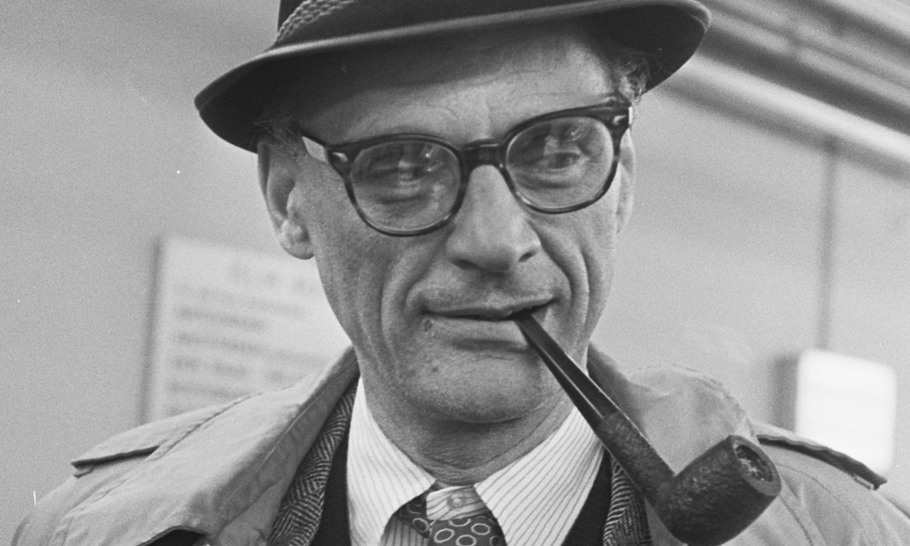
Arthur Miller in 1966
The last few months have seen an extraordinary revival of interest in the work of Arthur Miller. First, there was an acclaimed production of his classic play, All My Sons, in the West End, with Bryan Cranston as Joe Keller, which first opened in New York in 1947. Then came Miller’s last great play, Broken Glass, first performed in New York in 1994 with Ron Rifkin and Dianne Wiest, and produced in London with Henry Goodman and then Antony Sher, and recently revived at The Young Vic. Now comes another great Miller play, The Price, written in 1967, and revived at the Marylebone Theatre. Over the years the main part of Gregory Solomon has been played by such famous actors as Eli Wallach, Danny DeVito, David Suchet and now Henry Goodman.
Two things are striking about these three plays: they were written almost half a century apart and they cover such different subjects. All My Sons was Miller’s breakthrough play. It tells the story of two brothers and their father, Joe Keller. Based on a true story, about a middle-aged businessman who has been exonerated after being charged with knowingly shipping defective aircraft engine cylinder heads from his factory during World War II, becoming (in his own words) “the guy who made 21 P-40s crash in Australia”. For over three years he has placed the blame on his partner and former neighbour, Steve Deever, although he himself committed the crime. When the truth comes out, Joe justifies his actions by claiming that he did it for his family. It shows the early influence of Ibsen on Miller’s work. It is a play about guilt, but also, critically, about fathers and sons, like many of his best plays, including Death of a Salesman and, later, The Price.
Broken Glass could not be more different. Phillip Gellburg works for a major mortgage bank in New York. Then at the end of 1938 his wife Sylvia is suddenly partially paralysed from the waist down, after reading about the events of Kristallnacht in the newspaper. Phillip contacts Dr Harry Hyman, who believes Sylvia’s paralysis is psychosomatic. Throughout the play, Dr Hyman learns more about the problems Sylvia is having in her marriage.
Broken Glass is about the different ways Phillip and Sylvia respond to the crisis of growing Nazi antisemitism. She is obsessed with the terrible news from Germany, while he is remarkably indifferent. When Dr. Hyman asks Gellburg if he’s been following the story in the papers, his reply is telling: “Well, yes, but not much.” He doesn’t care about the plight of Germany’s Jews, many of whom are now refugees (“I sympathise with these refugees, but…”).
What is fascinating about Broken Glass is that it’s Miller’s greatest play to confront issues about Jewishness and antisemitism. One of the mysteries of Miller’s astonishing career is his lack of interest in Jews or the Holocaust in the 1940s and 50s l. This changed with Incident at Vichy (1964), his TV drama Playing for Time (1980) and Broken Glass (1994). Yet there is not a single reference to Jews in Miller’s 52-page 1958 Introduction to his early plays. There is plenty of Christian imagery in All My Sons, and yet there are also distinctively Jewish rhythms of speech: “What, killed?” “What ice does that cut?” “I spoiled the both of you.”
Indeed, perhaps a key reason for Miller’s fame was that in his heyday he wasn’t interested in Jews but in humanism and universalism, questions about what kind of man one should be, not what is it is like to live as a Jew in an antisemitic world. How much was this because of Miller’s sensitivity to American antisemitism in the 1940s and 50s, a time of general silence about the Holocaust? Was Miller’s growing interest in the Holocaust a response to a larger shift in later years?
Broken Glass is the first time Miller takes his great subject, denial, which is at the heart of so many of his best plays, from Death of a Salesman to All My Sons, and places it at the heart of a play about a Jewish couple and their different ways of responding to the rise of Nazism. At the centre of all his great plays is self-deception, living a lie. This is exactly what Phillip Gellburg does in Broken Glass until his wife forces him to confront what is happening to Jews in Nazi Germany.
The Price, curiously, is not just a play in two acts. It is two plays in one. The first is about a policeman, Victor Franz, who wants to sell his parents’ old furniture and contacts Gregory Solomon, a Russian-Jewish antique dealer, who comes round and makes an offer for Victor’s furniture. The second act is about the conflicts between Victor and his brother, Walter, a hugely successful doctor, who has lived the life Victor could have had.
All three revivals are superbly directed and well acted and they remind us why Miller was the greatest modern American playwright. They show us the huge influence of Ibsen on Miller’s work, especially in his heyday during the 1940s and 1950s, especially the subjects of guilt and denial. But they also remind us that, except perhaps for Broken Glass, at the heart of Miller’s best plays is the subject of fathers and sons: the shadow fathers cast over their sons and how difficult it is for these sons to get away from this shadow. Women are generally peripheral. So too are Jews, which is perhaps surprising given Miller’s Jewishness. Broken Glass is the great exception in both cases.
The big question is: why is there such a Miller revival now? Why does he speak to us with his powerful family dramas. In part, they are stories about the past: Kristallnacht and antisemitism in Broken Glass, the economic crash in 1930s America in The Price and who made money and at what cost during World War II. But above all they are stories about broken families and how they get torn apart, a timeless subject now as it was in the 1940s and 1960s.
A Message from TheArticle
We are the only publication that’s committed to covering every angle. We have an important contribution to make, one that’s needed now more than ever, and we need your help to continue publishing throughout these hard economic times. So please, make a donation.


